
Single-Issue | Non-partisan | 501(c)(4)

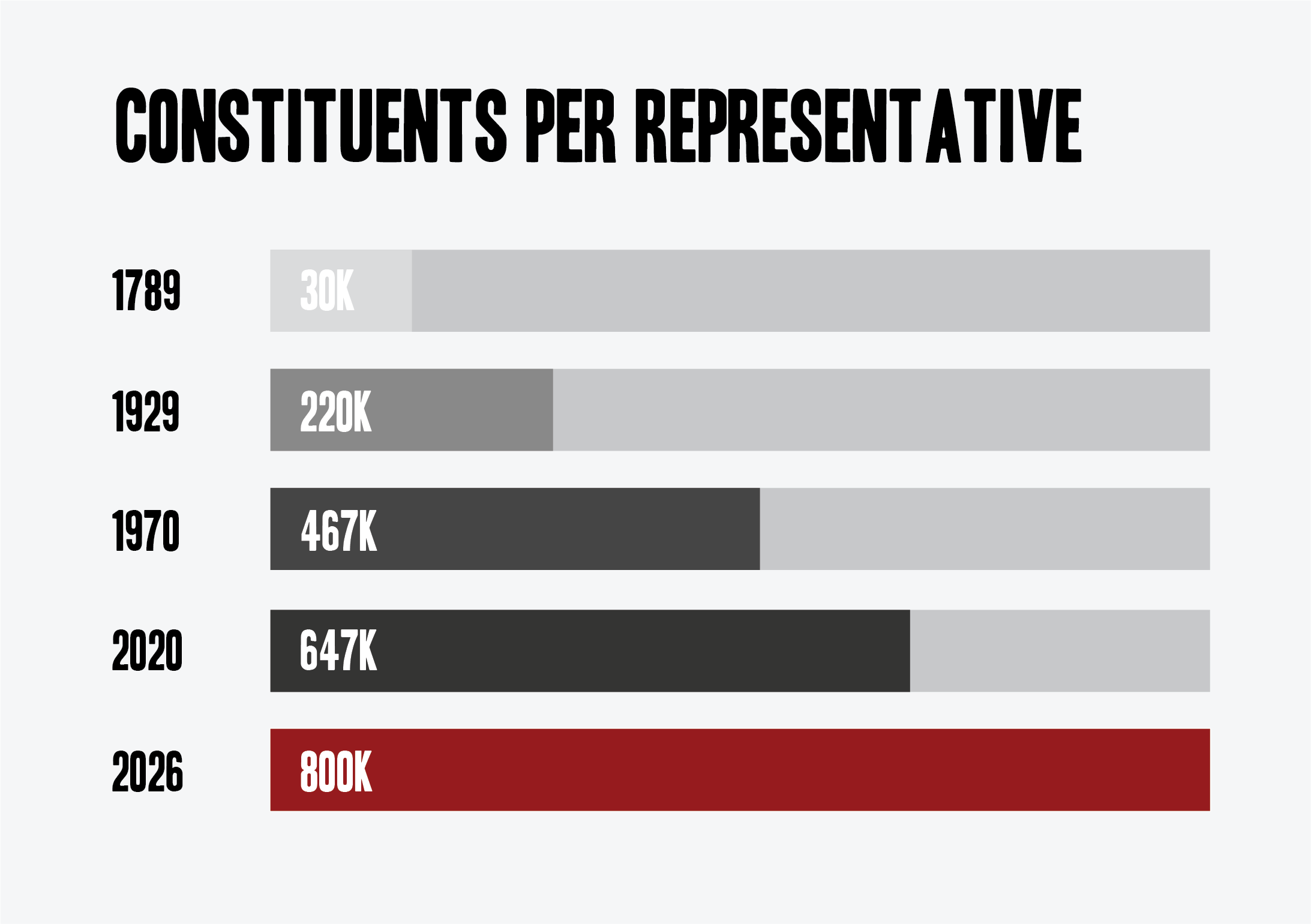
The House of Representatives has been capped at 435 seats since 1929, while the population tripled. One representative now speaks for nearly 800,000 Americans. It’s time for a change.
Why, in a country of over 330 million people, do we have only 435 representatives to serve them? Watch Mr. Beat explain.
What the media is saying
New York Times | Washington Post | The Atlantic | TIME | Pew Research | The Hill | The Dispatch | NPR | USA Today
"The U.S. has one representative for every 747,000 Americans — the highest ratio in its history, and the highest among peer democracies."
— Pew Research Center
Sign up to volunteer: get a free why 435 tee
We are a movement of, by, and for the people. Help us spread the word and receive a free Why 435 T-shirt after onboarding.

Why 435?
Why does the house size matter?
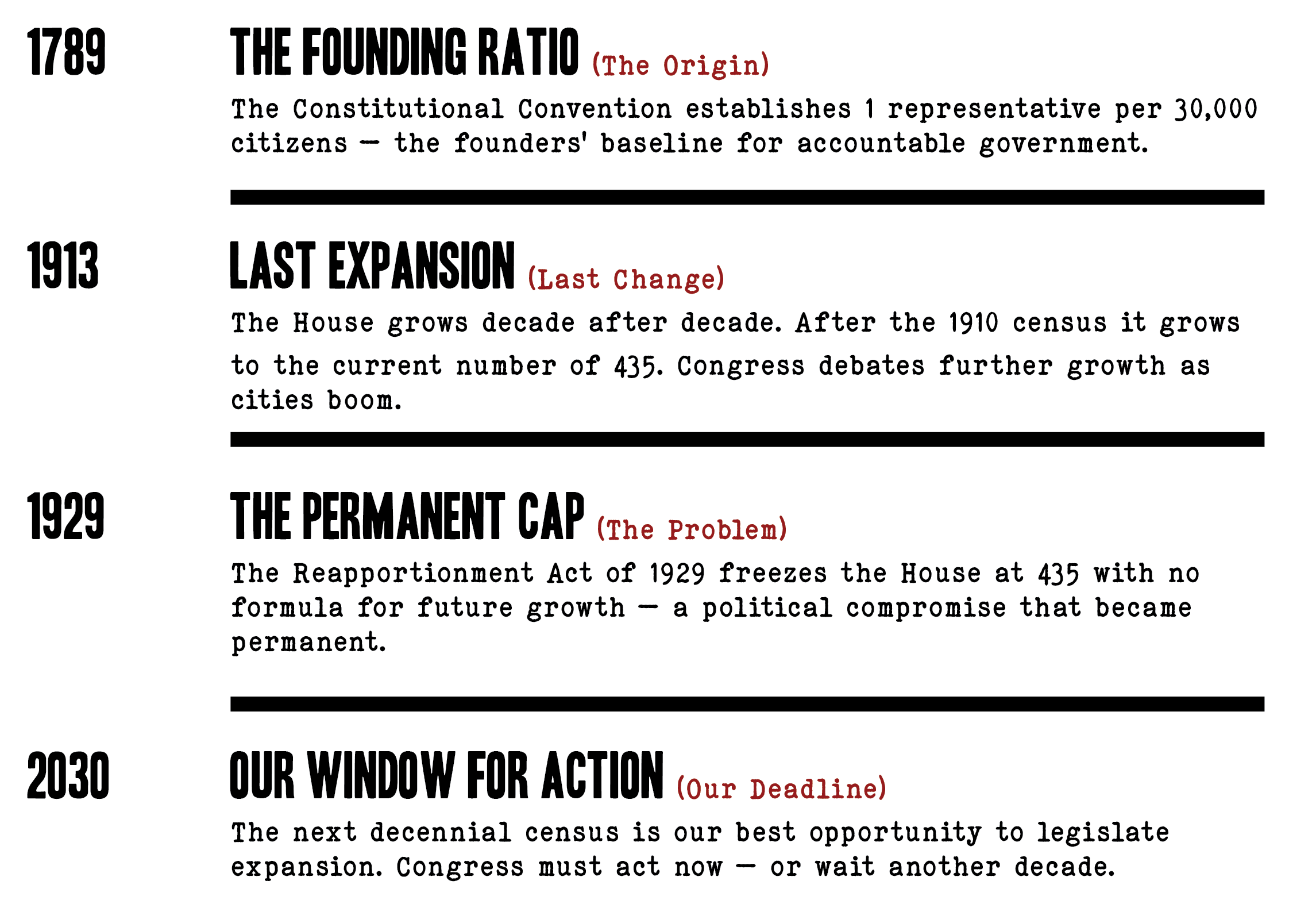
George Washington's only intervention at the Constitutional Convention was a warning: don't let the ratio of representatives to citizens get too small.
Congress ignored that in 1929, freezing the House at 435 seats. The population has tripled since. Your rep now speaks for nearly 800,000 people — more than three times what it was when the cap was put in place.
The consequences are visible: easier gerrymandering, more expensive campaigns, and a Congress that feels further from ordinary people than ever.
Self-government. Your voice. Tell Congress: Uncap the house
Email your rep using our template — and make it yours!
Congressional staffers get thousands of letters. Adding even 1-2 positive sentences about your district, your community, or something important to you about this issue makes your message stand out and dramatically increases the chance of a real response.
We are a non-partisan movement — Republicans, Democrats, and Independents united by one belief: that Americans deserve a government that actually represents them.
Join the Coalition.
FAQ
-
Uncapping the House means repealing the Permanent Apportionment Act of 1929. The act limited the number of representatives in the House to 435. “Uncapping” would remove that limit.
When the act was written, the population was about 100 million, and today it’s over 330 million. This has separated the people and their representatives.
As a result, America is now one of the least represented democracies in the world.
-
Yes. But it would require modernization and reconfiguration.
As noted in an article in The Washington Post, Danielle Allen has explained that the current size of the House chamber reflects 20th-century choices, not constitutional limits. The chamber was last expanded in 1913, and the permanent cap of 435 members dates to 1929, when the U.S. population was less than one-third of today’s.
The United States Capitol has been repeatedly renovated and expanded over time, including the addition of office buildings and underground facilities. Options to accommodate a larger House include:
Reconfiguring seating layouts
Using electronic voting and updated chamber design
Modifying the House floor footprint
Conducting some proceedings through hybrid or remote systems
In short, yes, but with some reengineering.
-
Item Gerrymandering is the result of political parties gaming for power, which is unlikely to be eliminated; however, uncapping the House would significantly reduce its impact. Smaller districts are harder to distort because it’s easier for the people to reach them.
When districts contain nearly 800,000 people, map-drawers can manipulate large populations with relatively few lines. Smaller districts mean:
More precise representation of communities
Less “packing and cracking” power per district
More competitive seats, especially in growing suburbs
Harder-to-sustain extreme district shapes
The larger the district, the more distortion a single line can create. By reducing district size, uncapping the House makes maps more granular and less powerful as a partisan weapon. Uncapping the House makes gerrymandering less structurally potent.
description
-
The 2030 census is fast approaching, triggering the next congressional reapportionment. Congress must repeal the Permanent Apportionment Act of 1929 before that census cycle, otherwise the country simply locks in the same representation system for another decade.
At the same time, the country is approaching the 100-year anniversary of the 1929 Apportionment Act. This provides Americans with an opportunity to reassess whether that decision still serves a nation that has nearly tripled in population.
Moments like this—major census cycles and historic anniversaries—are when institutional reforms become politically possible. If the conversation does not happen now, the issue may be deferred for another ten years or more.
-
No. Just a simple bill.
No Cap Swag

As we celebrate the 250th anniversary of these United States of America, let us remember what makes America great: YOU. And your participation in self-government.
America runs on representation.
*Men’s and ladies’ come in Oatmeal Heather, Youth comes in white.

You are in this for the future. Spread the word with our Engaged Citizen bundle. Receive 3 t-shirts, 5 Why 435 buttons, 2 Project No Cap bumper stickers, and 10 WHY 435 stickers.
The Why 435? CVC Tee delivers everyday comfort with a premium feel. Made from a lightweight 4.3-ounce combed ring-spun cotton/poly blend, it’s exceptionally soft, smooth, and built to hold its shape, offering a clean, modern look. A true go-to tee for the citizen looking to have a voice in their government.

Ask Congress to do its job. With this soft tee, you’ll look good, feel comfortable, and send the right message to restore representative government.
What the Experts are saying
Support the No Cap Movement
Project No Cap is powered by volunteers and small-dollar donors who believe every American deserves a government that actually represents them. Your gift helps us build the case, organize communities, and push this reform forward.
We are
A 501(c)(4) incorporated in Wyoming.
916 E Grand Avenue, Laramie, WY, 82070